Translate

Friday, June 1, 2012

Brendan Behan (1923-1964)

*
Brendan Behan (1923-1964) was an Irish poet, short story writer, novelist and playwright who was also a member of the Irish Republican Army. He was born in Dublin to a working class family. His father was a house painter who had been active in the Irish War of Independence, and was himself an educated man and a fan of literature and history. His mother was even more political, and had been a personal friend of Michael Collins. Brendan Behan had a brother, Brian, who was also a well known playwright and radical political activist, and two of his uncles were political and known songwriters. Behan left school at the age of 13, and already was reported to be heavily using alcohol, a demon that would curse him his entire life. At the age of 14, Behan joined the Fianna Eireann, the IRA youth movement, and began publishing some of his works in the IRA magazine.


Behan joined the IRA when he was 16 years old, and was sent to England to blow up the docks in Liverpool. He was arrested in possession of explosives, and imprisoned in a reform school (Borstal school), which he later wrote about in his autobiography "Borstal Boy." In 1942, Behan was again tried, this time for the attempted murder of two detectives in Dublin. He was sentenced to 14 years in prison, incarcerated at the Mountjoy prison. He wrote about his prison life in "Confessions of an Irish Rebel."

He was released in 1946 under an amnesty. He was imprisoned again in 1947 for trying to break out a fellow prisoner from jail. He later left the IRA, although he remained good friends with many of the members throughout his life. Brendan Behan learned the Irish language while in prison, and after that wrote in both English and Irish.

In Easter Week, 1916, there was a revolutionary uprising in Ireland in an effort to overthrow the English.  Most of the Irish who stood against the English were immediately slaughtered, but Ireland soon gained its freedom.  One of Brendan Behan's famous poems was titled "Who Fears To Speak Of Easter Week," calling on Irish people to continue their struggle for complete independence from England.   


Behan left Ireland for a time in the 1950s, and went to live in Paris where he reportedly earned a living writing pornography. When he returned to Ireland, he had developed a discipline to make sure that he continued his writing, instead of just wasting his life sitting in pubs drinking. He would get up early in the morning, and write steadily until noon when the pubs opened.  Then he went to drink.


In 1954 his play "The Quare Fellow" was produced.  It is about his experience in prison, and about an inmate who is going to be hung. The play brought attention to Behan and to the issue of capital punishment. Soon the play was being shown in a West End theatre in London. Behan was becoming a minor celebrity, and was invited on a popular television show, where he appeared quite drunk. Jackie Gleason was also a guest on the show, took a liking to Behan, and the two become good friends.

At the end of The Quare Fellow, the song "The Auld Triangle" is sung. The Auld Triangle (sometimes called The Banks of the Royal Canal) was written by Brendan's brother, Dominic Behan. This has since become a popular song, performed by many Irish artists, considered by many to be a modern Irish anthem. The triangle in the song is a reference to a triangle which hung in the prison where Brendan Behan served time. The song takes place on the day one of the prisoners is to be executed. Among the artists who have performed or recorded The Auld Triangle are The Dubliners, The Pogues, The Dropkick Murphys, U2, Bob Dylan and the Band, Eric Burdon, and Glen Hansard.


Soon the play was also showing on Broadway, and Behan gained an international following. He spent much of the rest of his very short life drunk, and turning out well-respected work, widely hailed as one of the most important Irish writers of his generation. Unfortunately his heavy use of alcohol caused serious health problems including diabetic comas and seizures. Finally, in March of 1964, at the young age of 41, Behan collapsed in a bar, and was taken to a nearby hospital where he died.  He had an Irish Republican Army funeral. 

Perhaps not surprisingly, Behan was a major influence in the writings of Shane MacGowan. He is the subject of a song by the Pogues titled "Streams of Whiskey," and is mentioned in "Thousands Are Sailing." The Clancy Brothers recorded their own version of "Lament for Brendan Behan." The Lament for Brendan Behan by Fred Geis has also become a standard for many Irish singers.

Monday, May 21, 2012

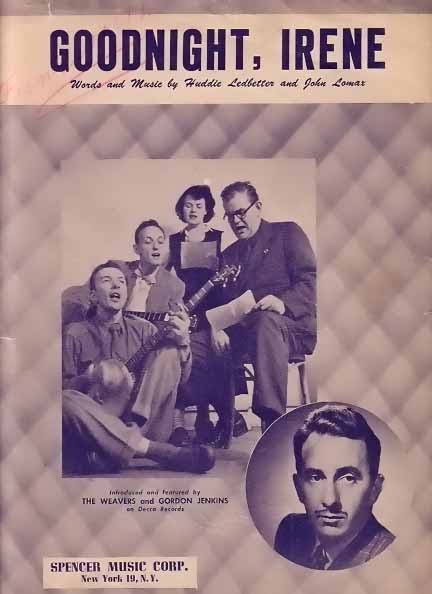
Goodnight Irene

*

The song "Goodnight Irene" was written and first recorded by Huddy Ledbetter (aka Leadbelly) in around 1932, during the height of that other depression. The song was derived from an old folk song, but Leadbelly wrote his own verses and made the song his own.


While Leadbelly was in prison in the Lousiana State Pentitentiary (aka Angola) John and Alan Lomax learned about his music, and soon began recording Leadbelly's songs to preserve them as a part of America's culture for the Library of Congress. As was common at that time, the song never gained national recognition or particular popularity when recorded by a black artist. White America still mostly listened only to white performers. Long after his death, the Grammys awarded Lead Belly's 1936 Library of Congress recording of the song a "Grammy Hall of Fame" award.


The Weavers was the name of a folk music group in Greenwich Village, New York, consisting of Ronnie Gilbert, Lee Hays, Fred Hellerman, and Pete Seeger. In their early days, they performed mostly at the Village Vanguard. Soon after Leadbelly's death, in 1950, the Weavers recorded Goodnight Irene, and it became an enormous hit for them.


Immediately after gaining their first success, the Weavers became victims of the McCarthy era anti-communist witch-hunts, and were blacklisted. Their label dropped them, radio and TV refused to play their songs, and if they appeared in person they were hounded and harassed by the FBI and the right-wing. The group disbanded in 1952 because they could not find work, but in 1955 they held a reunion concert at Carnegie Hall, which sold out.

The song Goodnight Irene eventually became a classic, a standard in the American songbook.

Among other famous performers who have recorded Huddy Ledbetter's song "Goodnight Irene" are Frank Sinatra, Willie Nelson, the Pogues, Johnny Cash, Mississippi John Hurt, Little Richard, Jimi Hendrix, The Kingston Trio, Ry Cooder, Tom Waits, and John Sebastian.


Different performers have altered the original lyrics of Leadbelly which, when written, were both dark and somewhat controversial, talking about the misery of disappointment in love, possible suicide. "sometimes I take a great notion to jump in the river and drown," which was the inspiration for the 1964 novel "Sometimes A Great Notion," by Ken Kesey.

Saturday, May 19, 2012

Happy Birthday Malcolm X ( May 19, 1925 – February 21, 1965)

*
Happy Birthday Malcolm X (May 19, 1925 - February 21, 1965)


Excerpts from a famous speech by Malcolm X:  The Ballot Or The Bullet.

"Feminism" is the radical concept that women are human beings.

*

Feminists are female humans who understand the institutional existence and effect of sexism on their lives and on the lives of all other women. All women, for example, are prey, potential victims of domestic violence from some man who claims to own our bodies, potential rape victims from strangers or invading armies. We are generally despised, disregarded, demeaned, humiliated, overworked and underpaid in all nations. There is no place to which we can escape, because the oppression is international. We are not brutalized because of something we did. It is not our fault. It is institutional sexism.

Not all men are hateful or cruel, but they are all raised in societies which teach men that women are inferior, stupid, dishonest, untrustworthy, useless past the age of 40. It takes a lot of insight for men to overcome that conditioning, but those who at least struggle can be good companions.

Women are raised in sexist societies and also incorporate the same basic disdain for themselves and for other women. We not only berate ourselves, isolate because we consider ourselves inferior and inadequate, but we also join in ridiculing other women because when we do that, we get credit from the boys.

Women turn over complete control of their bodies to men. We allow men to dictate that the only attractive woman is one who is skeletel, with plastic ballons full of chemicals surgically inserted under their chest walls, and paralyzing agents injected into our faces to freeze the muscles and disguise the wrinkles. This is now normal, not bizarre. It is admired, not condemned. Magazines routinely show photos of women then discuss how fat they are, at a size 4 or 6, because today a size 0 or 2 is expected. During World War II, sizes 10 and 12 were the standard for movie stars.

The people who run the world, steal the money, condemn people to die from illness and children to live in hunger, those who start wars and murder and rape, who destroy homes, are mostly men. Anybody wants to pick apart the legacy of teachings of a person, choose a man. No need to pick on the few feminists who have a name. It helps the bad guys to do that.


Rush Limbaugh, the deaf morbidly obese impotent drug addict on the radio, calls women who speak up for their own rights "feminazis." Many men think this is clever, so they use the term too. Luckily women are used to being ridiculed and demeaned, criticized, excluded from opportunity, and paid only 79% of what men are paid for the same job. I say luckily, because we need thick skins to continue to speak up and stand up for our rights, and against men who humiliate and demean other women.

Always remember: men were the rough draft.  Women are the masterpiece.

When will this country finally give women equal rights under our laws?

*


The Equal Rights Amendment was first introduced in Congress in 1923.  It has still never been passed.  That's because the mostly-male Congress believes women are inferior, and not entitled to legal rights.  Here is the "radical" language of that amendment:  "Equality of rights under the law shall not be denied or abridged by the United States or by any State on account of sex."

Thursday, May 17, 2012

Social Realism

*

Social realism is an artistic movement which first started in the 1930s during the Great Depression. It was seen in art, books and film. Social realism rejects the romanticized view of life and instead truthfully shows poverty, discrimination, and the difficult life of the working class. Social realism discards superstition and mysticism, both of which are often featured in other films to distract people from the hopelessness of their situation.


Social Realism often focuses on critical issues in a society which tend to be denied, ignored, or covered up by mainstream media and politicians. By showing a truthful portrait, it also suggests a political message, that the money hoarded by the rich should be redistributed, and that no person should be forced to live in poverty.


Among the artists whose styles represented social realism were Edward Hopper and Walker Evans.


Most of the Social Realism work became popular before the anti-communist movement of the late 1940s and 1950s. The fact is that the Social Realism movement reflected the horrendous burdens placed onto most working people in this country, living in severe poverty without any hope, being watched over by the ultra-rich living in penthouses and spending their lives being self-indulgent.


By the late 1940s, any book or movie, any politician or social movement which called attention to poverty, injustice and discrimination, was attacked as being communistic, and people who spoke of such things would be hounded by the FBI, thrown out of work, exiled in their communities. The Social Realism movement was ended by the nationalistic patriotism of World War II, but the final nail was put in the coffin by the post-war anti-communist hysteria. Best not to speak of things like poverty, injustice, prejudice, inequality, and corruption.


In film, many of the movies of the 1930s reflect this style including Grand Hotel and Dinner at Eight. The Grapes of Wrath, both the book and the film, are typical of Social Realism of the time.


One of the best of the Social Realism movies was Dead End.  It starred Humphrey Bogart, Joel McCrea, Silvia Sidney, Claire Trevor, Marjorie Main, and the Dead End Kids. This movie takes place on the east side of Manhattan where the ultra-wealthy live in mansions, and the poor survive in the streets below, turning to crime, prostitution and despair. No hope, no opportunity, nowhere to go.